May 18, 2026

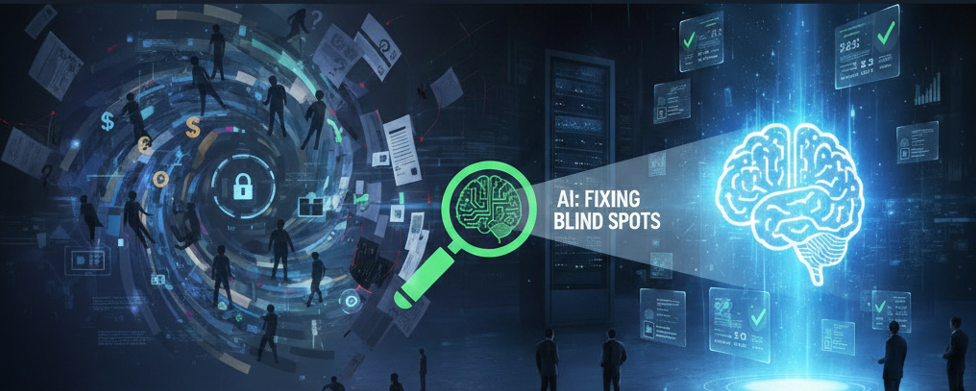
Contract Intelligence: How AI Is Fixing Procurement’s Blind Spots

Most procurement value is not won at the negotiation table; it is lost after the ink dries. New research finds that organizations leak an average of 11% of total contract value after signature, roughly $55M in annual losses for an enterprise with $500M in contracted spend. Deloitte and Docusign put the global figure at over $2 trillion annually. Yet 95% of organizations admit they lack full visibility into their contractual obligations, and fewer than 8% rate their contracting processes as "excellent."

This is not a documentation problem. It is a system-design problem. Contracts have quietly become procurement's largest blind spot, and AI is the first technology capable of closing it.

1. Why Contract Blind Spots Persist

Contract blind spots are not the product of negligence. They are a structural byproduct of how modern procurement operates.

  • Volume has outpaced capacity. A mid-sized enterprise routinely holds tens of thousands of active agreements across business units, geographies, and currencies. Manual review and tracking cannot scale to that footprint.
  • Contracts live as static documents. Most agreements are signed PDFs stored in shared drives, email threads, or fragmented repositories. Once executed, their terms stop being actionable data and become buried text.
  • The post-signature handover is broken. Procurement and legal exit at signature; operations, finance, and business teams take over without the commercial context to enforce the deal.
  • Obligations depend on memory, not on systems. Renewal dates, price escalators, SLA penalties, rebate triggers, and exit windows are still tracked through spreadsheets, calendar reminders, and individual recall — all of which fail at scale.

2. The Real Cost of the Blind Spots

The losses are not theoretical. They compound quietly and surface late.

  • Unwanted auto-renewals. Organizations continue to lose significant value when contracts quietly auto-renew on unfavorable terms, while most businesses still struggle to manage renewals at scale.
  • Untracked obligations. Missed rebates, unenforced SLAs, and expired price holds account for 2–3% of spend on their own.
  • Off-contract and duplicate spend. When teams cannot locate an existing agreement, they buy outside it, eroding negotiated pricing and creating shadow vendor relationships.
  • Audit and regulatory exposure. Missing data privacy clauses, outdated force majeure language, and unmonitored compliance terms tend to surface during audits or incidents, when remediation is most expensive.

Each of these is small in isolation. Together, they explain why the average enterprise loses double-digit percentages of every dollar it commits to a contract.

3. What Contract Intelligence Actually Does

Contract intelligence is not a digital repository, a search bar, or another dashboard. It is a layer of applied AI that converts contracts from static text into structured, queryable, continuously monitored commercial data. Done well, it delivers four capabilities simultaneously.

  • Extraction at scale. AI parses every clause, party, date, obligation, and commercial term across the entire contract estate, including legacy paper agreements. NDAs that take a human lawyer roughly 92 minutes can be reviewed in seconds at 94% accuracy.
  • Proactive obligation and renewal monitoring. Renewal windows, notice periods, milestone deliveries, and price escalators are surfaced 30, 60, and 90 days in advance — before they trigger automatically and negotiating leverage is lost.
  • Risk and deviation detection. Non-standard clauses, missing indemnification, unlimited liability exposure, and outdated regulatory language are flagged against a standard playbook, rather than discovered during a dispute or audit.
  • Portfolio-level intelligence. Procurement can query the entire portfolio in natural language: "Which contracts auto-renew in Q3?", "Where are we exposed to unilateral price increases?", and "Which suppliers serve three business units on different terms?" — turning the contract base into a strategic decision-making asset.

The trajectory is clear: AI-enabled contract tools are moving from early pilots to mainstream adoption. The differentiator now is execution.

4. What Separates Procurement Leaders from the Rest

The organizations recovering the most value have rewired how contracts are owned, governed, and operationalized after signature — not just how they're negotiated before it.

They have dismantled the post-signature handover. Ownership no longer evaporates when procurement and legal exit the deal; a defined function carries the commercial intent of the contract into operations, finance, and the business.

They have codified negotiation playbooks into structured, machine-readable standards: clause libraries, fallback positions, and risk thresholds — so that deviations are caught against an objective reference rather than negotiated case-by-case.

They have integrated contract data with spend, supplier, and ERP systems, so obligations flow automatically into purchase orders, invoices, and supplier scorecards rather than living in a parallel universe of PDFs.

And most importantly, they have rewritten the scorecard. Leaders measure contracts on post-signature outcomes — realized savings, captured rebates, prevented auto-renewals — not on pre-award metrics like negotiated savings or cycle time. The deal you negotiated only matters if it's the deal you actually receive.

5. Closing Perspective

The next generation of procurement will not simply manage contracts; it will operate them. Value will be tracked, flagged, and recovered in real time, instead of leaking quietly after signature.

AI does not replace negotiators or category managers. It helps ensure that the deal negotiated is the deal delivered. In this model, contracts are no longer static legal records. They become living commercial assets: continuously read, monitored, and enforced.

Winning organizations will not get there by hiring more analysts or adding another repository. They will get there by making intelligence a built-in layer of every contract they sign.

Take our quick 5-minute AI Readiness Assessment to evaluate where your organization stands.

If you want a clearer view of how your contracting architecture should evolve, engage Valorant today.

Locations
Chicago
New Jersey
London
Bengaluru
© 2023 — Copyright