April 13, 2026

Ask a procurement team what they paid for a fastener last quarter - they'll tell you to the decimal. Ask what each active part number actually costs the business end-to-end, and you'll get silence. That silence is expensive.
SKU and part proliferation doesn't announce itself. It accumulates - one customer variant, one bespoke component, one regional specification at a time. A 2024 study in the International Journal of Production Economics is unambiguous: adding variants whenever capacity looks available "can cause unbearable cash flow issues and profit losses" because the cost is invisible at the point of the decision.⁴ A significant share is also accidental, engineers creating part numbers that already exist elsewhere in the system, simply because no one gave them the tools to check.

The cost lands across the whole operation: fragmented supplier volumes, slower production runs, slow-moving inventory carrying a 10-35% annual charge, and overhead absorbed into your best product lines rather than traced to its source. None of it shows up as a single line item. All of it is real.
A fabricated parts data set from the industry makes this concrete. Across a sample of bracket assemblies sharing the same design control, unit prices varied up to 6x driven almost entirely by order fragmentation. Average unit price of low-volume parts were 5x higher than high-volume equivalents. Same part category. Same specification family. The difference is complexity.
"We are striving for lower complexity with over 20% reductions in SKUs, raw and packed materials, and number of suppliers."
Hein Schumacher, CEO Unilever, 2024
"Today I am pleased to announce actions to significantly sharpen our portfolio and simplify our organization for accelerated growth and value creation."
Kris Licht, CEO Reckitt, July 2024
Illinois Tool Works, a global industrial manufacturer explicitly mentioning Product Line Simplification (PLS) as a named, measured, recurring strategic discipline with direct margin impact in its quarterly reports: “Organic revenue growth was positive 0.4 percent adjusted for PLS reduction of 0.9 percent”
These aren't distressed businesses cutting costs under pressure. These are some of the world's most sophisticated manufacturers and consumer goods companies and they're all saying the same thing. Complexity reduction is a growth strategy, not a cost program.
In most manufacturers, adding a new part requires an engineering sign-off. Removing one is a political event. Capital expenditure needs approval. Headcount needs approval. A new part number which carries years of sourcing, inventory, and production cost often needs neither. That asymmetry is where the problem lives.
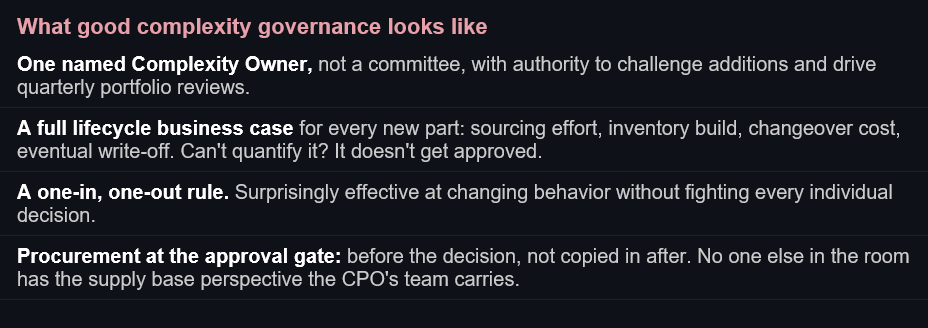
The manufacturers winning on cost aren't doing it through harder negotiation alone. They have made themselves simpler to operate. Fewer parts, deeper supplier relationships, leaner runs. Complexity reduction is a procurement strategy. It just doesn't always get called that.
That's usually where we start. Let's talk through it. Book a conversation.

Authored by:
Niral Mehta
Senior Manager - Valorant